
2.9 Sinopec – I experiment - Geophysical Experiment
In 2015, I had the opportunity to visit the Sinopec Geophysical Laboratory in Nanjing, China. I was introduced to a way of seismic modelling that I had never seen before and have not seen published in any international geophysical literature.
Physical Geologic Model Fabrication
They make a physical geologic model using different kinds of ceramic materials and fiber, creating a geological model with different refraction index values (similar to different acoustic impedance values) to model the seismic amplitude response.
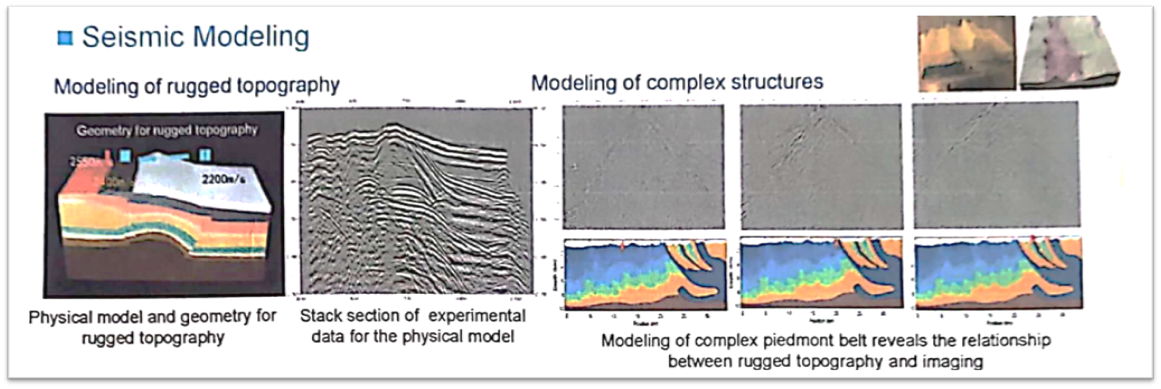
Fig. 1 Physical modelling of complex structures. The layout panels illustrate the physical model geometry for rugged topography, the corresponding stacked section of experimental data, and complex piedmont belt profiles showing the relationship between rugged topography and sub-surface imaging.
Ultrasonic Surveying & Outputs
The seismic survey is done by a “machine” using ultrasound. The experiment's output is a synthetic seismic dataset in SEG-Y format, which can be processed to evaluate the survey design.
Experimental variants include comparisons of ultrasonic seismic physical modeling responses using different sensor components, enabling contrast experiments between systems like Phase-Shifted Fiber Bragg Grating (PS-FBG) probes and Lead Zirconate Titanate (PZT) devices.
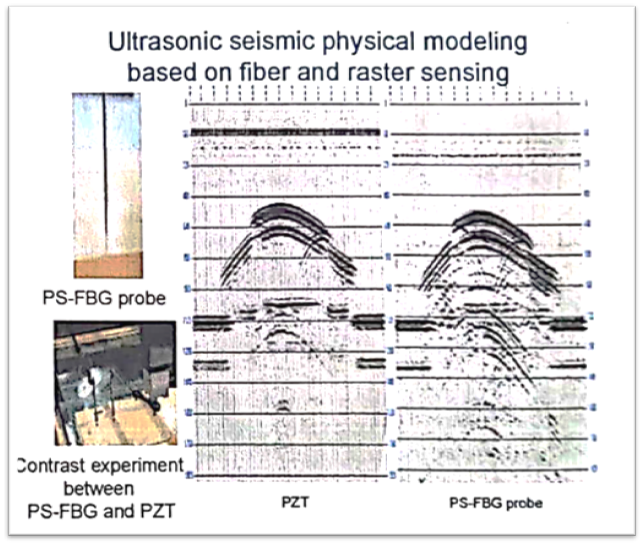
Fig. 2 Ultrasonic seismic modelling response for different materials. Displays the structural contrast experiment configurations and seismic trace output differences between traditional PZT components and advanced PS-FBG optical probes.
Successful Method Applications
This Sinopec proprietary method has succeeded in rugged topography and complex structure modelling (such as modeling of a complex piedmont belt to reveal the relationship between rugged topography and subsurface imaging), carbonate fracture-cave reservoir modelling, reservoir fluid detection and simulation, and unconventional reservoir study.